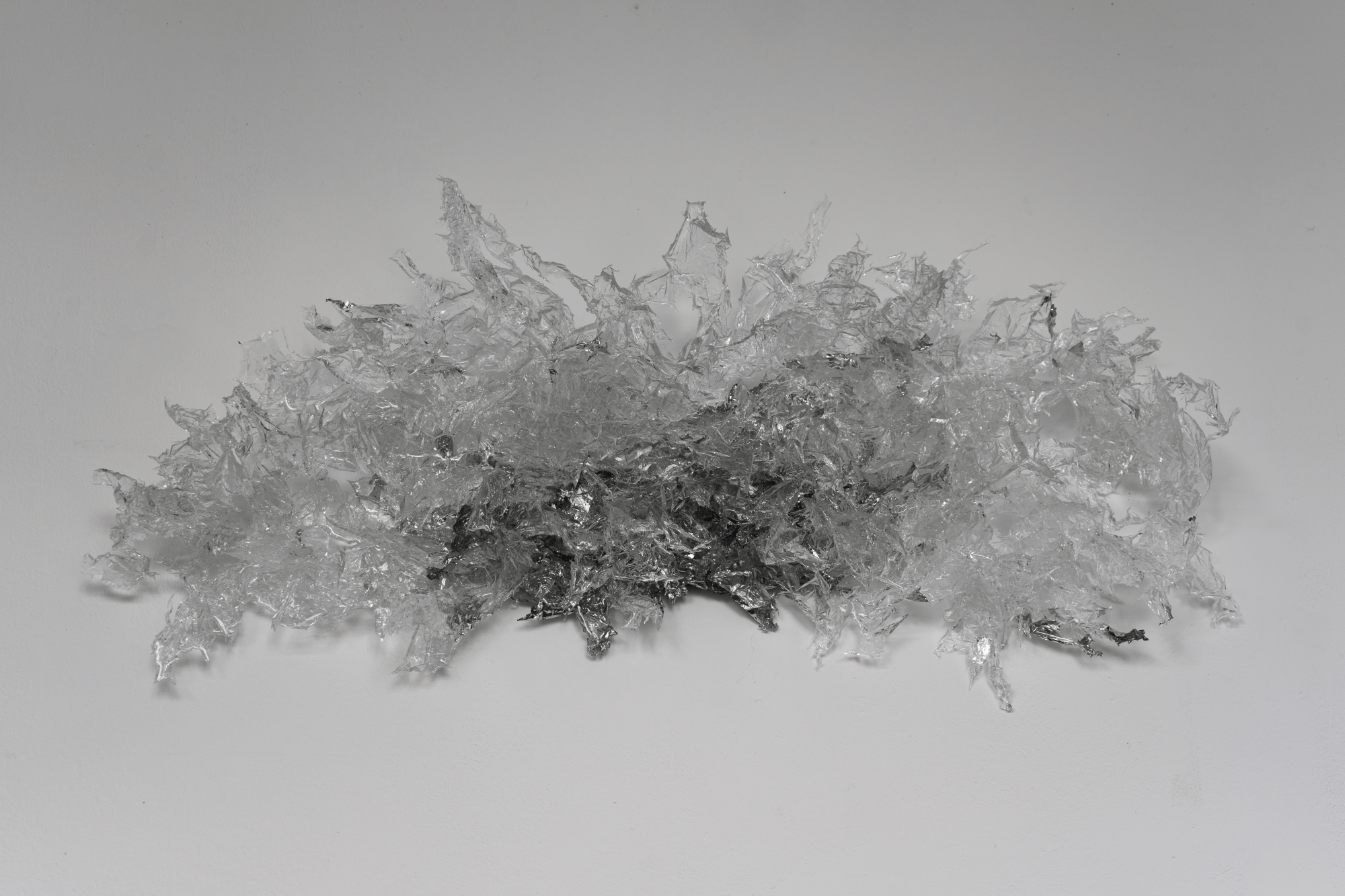
2025
95x43x15cm
Epoxy resin and Mylar film.
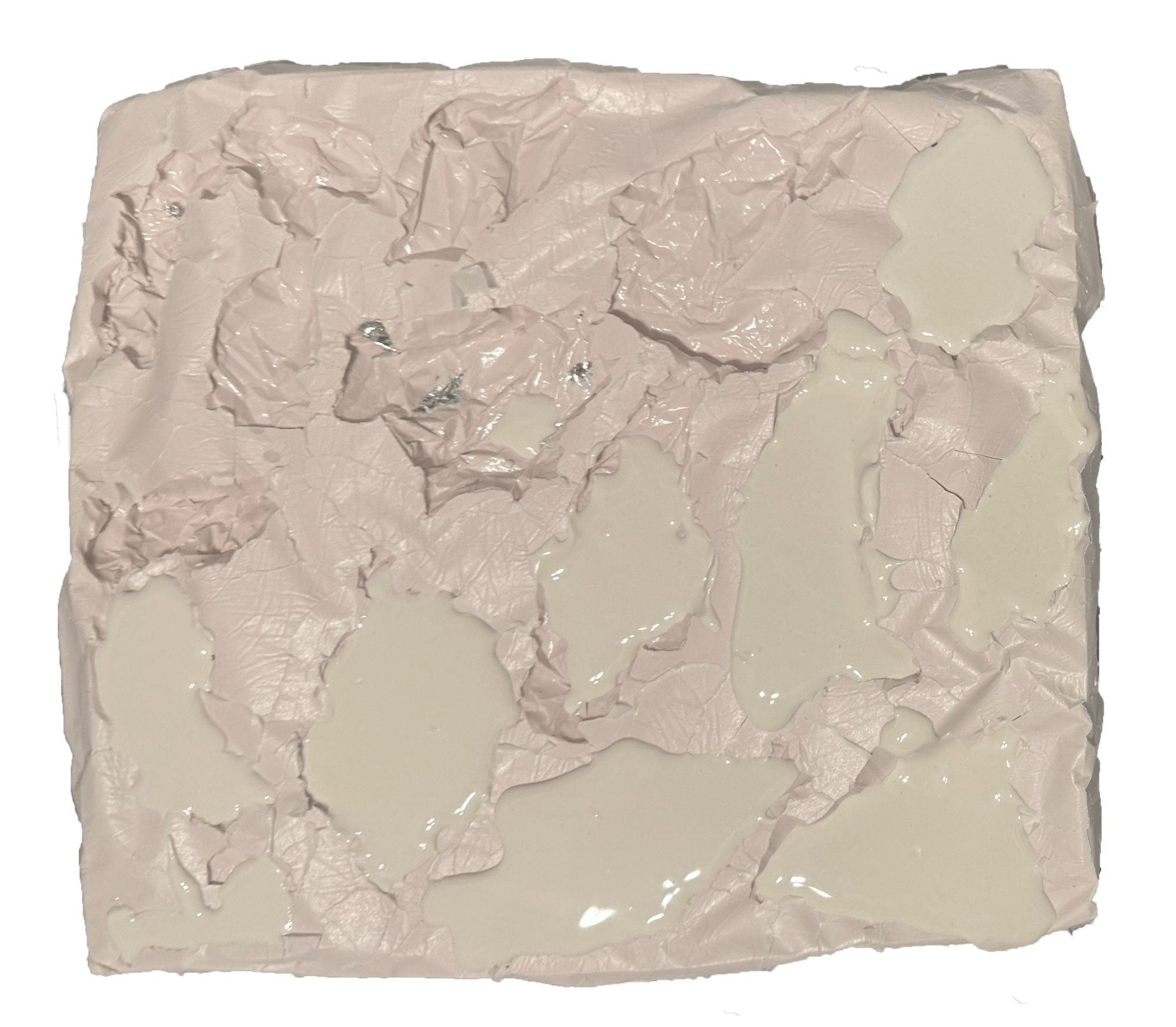
For my MA show in Unit 3, I made a new piece called Crystalline Bloom that continued my experimental methods from earlier work. I enlarged the overall scale of this work considerably and attempted to push the dimensionality even more. I wanted to make the composition feel more three-dimensional and had the transparency of the resin in mind to better evoke a crystal-like structure.
Using my previous experiments as a starting point, I focused on how light passes through different layers of resin and reflects off the crystals. Visitors can feel the depth and inner luminosity that I aim for through overlapping transparency.
Drawing on my experience with my prior pieces, I realised that using only two simple hooks at the back of the work to hang them made the supporting strings visible, which disrupted the seamless presentation that I wanted to achieve. To tackle this problem, I created an entirely new hanging. I created and built a bracket structure for the piece, meaning the piece sits flat against the wall like a floating object. My idea of merging material, structure and space as a visual whole was further supported by the enhancement in the presentation of my work.
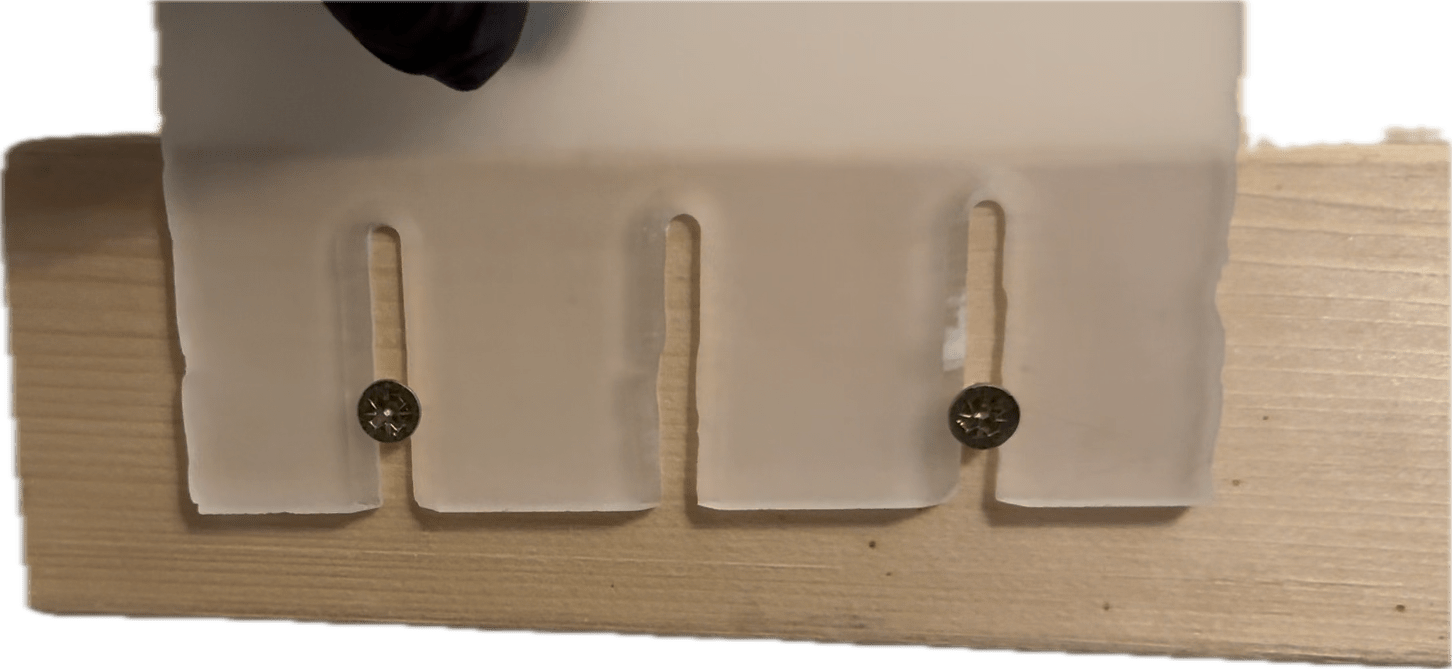
The image depicts me grasping the bracket I built for this task. Think of the two screws on the wooden piece as though they were screwed into the wall directly. When I want to put in the artwork, I just slide it down from the top onto the screws as it has carved slots on the acrylic sheet. This system keeps the artwork secured while being clean and seamless on the wall, Wall Light.
You might see that I intentionally roughened the edges and surface of the acrylic with sanding. The purpose of this was to enhance the adhesion of the resin to the acrylics.
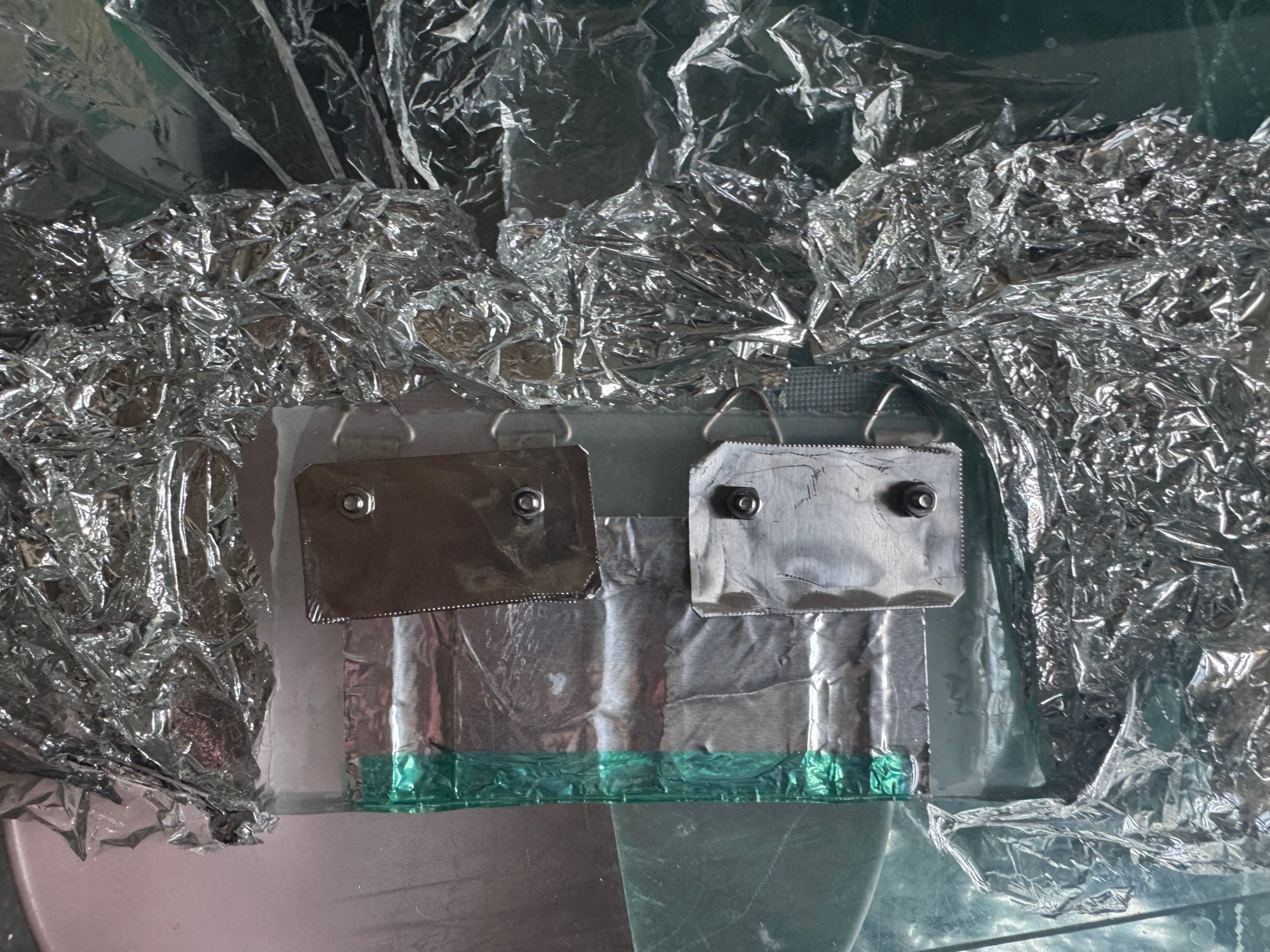
The artwork has had the bracket directly attached to it, you can see this in the image. This photo shows the back side of my work. You can see how I integrated the bracket into the piece. I also added four hanging rings, which will help with stability during installation. It will prevent the piece from falling accidentally while putting it on the wall.
I purposely made a strong section on the front side of the work so I would not have to worry about it falling apart when I handle it. This part is sturdier than the fragile edges around the piece, so that it can make contact safely and be installed without damage.
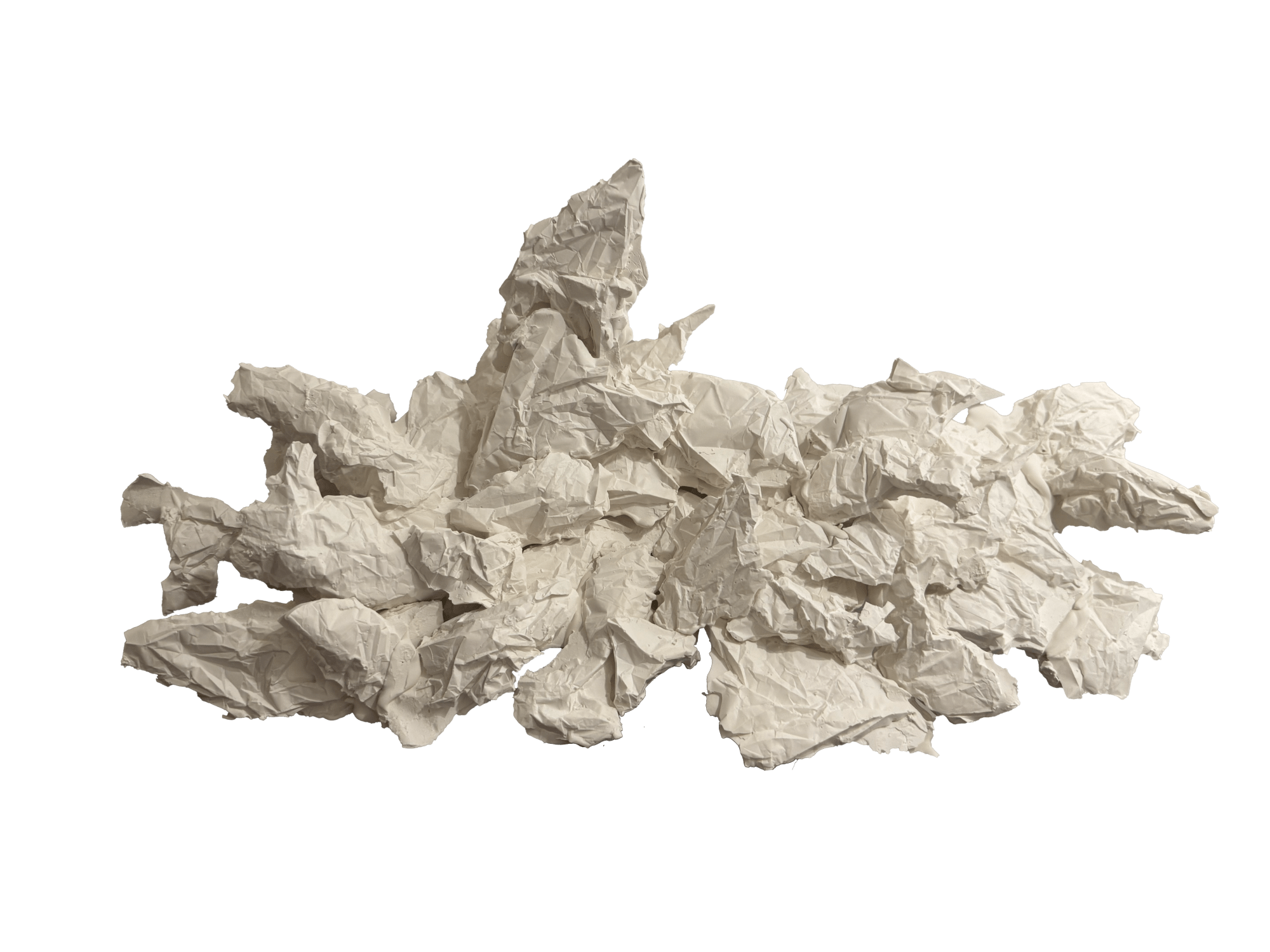
2025
45x22x12cm
Plaster
I went on to make the next piece out of an entirely different material, plaster. The work is titled Stillness. In this one, I continued with the same organic form and growth-like tendencies but used a crystalline structure as was there in before. However, this time, I replaced the resin with plaster.
When I started this experiment, I didn’t think much about its conceptual direction at the beginning. I just wanted to see what would happen when I used plaster instead of resin. However, after doing so, I immediately understood how different it was. The resin and reflective film have been stripped of the qualities that made the material transparent and reflective.
Instead, it adopted a whole new look. A crumpled ball of paper. Layered mountains. White mineral formations. My past works were interpreted based on light and reflective materials, so with the introduction of plaster, I wanted to create a work where opaqueness and texture evoke something quieter and a visual language that has a more grounded presence.
Since I changed to a totally different material, the working process has changed too. Plaster is much heavier than resin and does not capture little wrinkles or folds like resin can. I tried using the same casting method as before, but I quickly realised that it would not work with this material.
So, instead of casting plaster straight away, like how I worked around resin, I first moulded silicone rubber with my old resin components. I made moulds of the original resin pieces, which are used in making their replicas. I then used these silicone moulds to turn out the plaster versions of these forms.
In this photo, I was pouring plaster into the silicone mould for a sculpture. The picture is taken just after pouring the plaster when it is still liquid.
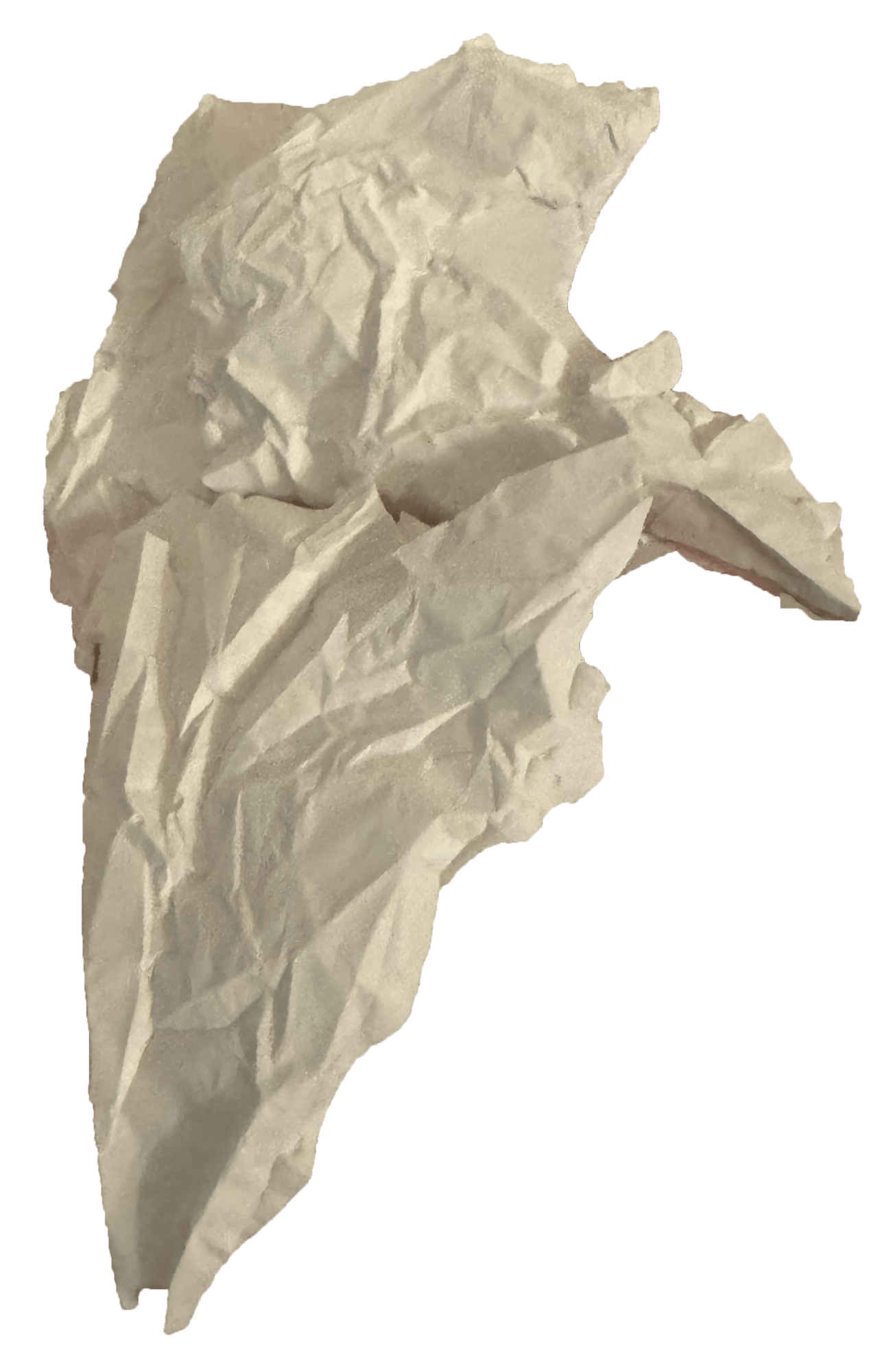
The plaster pieces are seen in this image after hardening. I was joining two solidified plaster parts with plaster in the picture. In my final work, they were connected in the same way and made up my complete sculpture.
In Unit 3, I further my journey into materials and spatial relationships through Crystalline Bloom and Stillness.
In the course of Crystalline Bloom, I further developed the techniques I had been refining in earlier experiments with resin and reflective materials, increasing the scale and enhancing the transparency to highlight the crystalline quality of that work. The new bracket system also allowed the piece to integrate more into the wall, in line with my aim of blurring the edge of the artwork with the wall surface.
In contrast, Stillness marked a shift in my material exploration. When I changed the material from resin to plaster, I realised how much that can alter the look and idea behind a work. When things lose their transparency and reflectivity, we feel weight, opacity, and stillness; we feel the feeling of time being stood still. By bringing together many small plaster units into a single piece, it brings up a new growth type that feels silent, solid and ages.
Both these works reflect my continuing interest in the transformation of materiality and how it alters perception, from airy to solid to see-through to opaque to animate to inanimate.
 Jimmy Zheng