Unit 2
I. The Influence of Roni Horn’s Library of Water on My Practice
Roni Horn’s artwork, “Library of Water” reflects upon nature, the materiality of water and transparency. In Stykkishólmur, Iceland, a former library has been transformed into a permanent installation featuring an immersive experience with 24 columns of water from Icelandic glaciers.

Roni Horn, 2007
The dynamic change of the sunlight, combined with the cylindrical container it reforms light, lighting a varied shape, making the gallery a dynamic space. A goal of the Installation will be to get people to engage with the work and one another.
According to Horn, water is not a thing but a verb; he thinks of water as something one experiences in its relationship to other things, not as a static thing. (Horn, 2005) Traditional beliefs hold that materials are simply passive media through which an artist expresses ideas. Rather, Horn positions water – and, by extension, different materials – as agents in making. The way I see epoxy resin has changed immensely since I discovered his work, and that influence can be seen throughout my work. Epoxy resin is not just a material that I manipulate, but rather something whose characteristics help form the final work. My work, similar to Horn’s glass columns in “Library of Water,” aims to show how materials can ‘show’ through their responses to light, space and time.
Horn’s narrative motivates my exploration of light and reflection through a clear medium. My wrinkled Mylar film works in conjunction with resin to produce a metallic reflection and layers of light and shadow. This lets me achieve close to the experience in Horn’s glass columns. The way the artist freezes time using transparent objects has motivated me to capture this motion and passage of time into “solid” resin.
Horn’s work reshapes sculpture’s connection to architecture and environmental art. I have switched from painting ordinarily to giving a three-dimensional expression within the architecture. Based on Horn’s work, I have left behind rectangular forms and embraced more fluid forms that respond to their environments.
Horn, R. (2005) ‘Water’, interviewed by Susan Sollins for Art21, September.
II. The Influence of Tim Ingold’s work on My Practice
I have changed how I create material and think due to Tim Ingold’s writing. In 2010, he wrote the essay, “The Textility of Making”, where he interrupts the traditional hylomorphic model – the one that states that form is imposed on a passive matter – and confirms making as a dialogic process.
This revelation resonated with my experience creating “Tilted Time,” where unexpected cracks emerged during demoulding. Rather than viewing these as failures, Ingold’s perspective helped me recognise them as evidence of the material’s voice in our creative conversation.
“Ingold taught me that making is not the imposition of form on matter but the discovery of the possible forms within the material itself” – this statement helped me think less control and more collaboration. When he wrote that materials ‘think in us as we think through them’ (Ingold, 2010, p. 94), he was able to give words to my experience. The materials weren’t just passively receiving and responding to my intentions and designs; rather, they were suggesting pathways. I began to flourish in complexity, learning not to reject or fight against it. I now have a new relationship with risk and uncertainty, seeing them as generative forces rather than obstructions to be overcome.
Timothy Ingold’s Making: Anthropology, Archaeology, Art and Architecture (2013) book expands on his ideas across a wide array of disciplines. It made me develop my understanding of material agency further. Through the development of “The Labyrinth” and “Crystal Interweave”, I began to think of resin and Mylar film not only as the means to my vision but as possessing qualities themselves. I developed from dominating flows of materials to listening to their resistances and transformations.
This shift in viewpoint transformed my studio work from creating to discovering. I set aside any preconceived ideas and allowed the materials to speak for themselves.
I used to impose my will on inert materials. I see myself as a co-creator who “becomes with” materials. My artworks no longer express a side. They are a record of communication between the artist and the medium.
Through Ingold, I now realise that making is a relationship with the material properties, tendencies and resistances of matter that informs the making process as much as my own creative intentions.
Ingold, T. (2010) ‘The textility of making’, Cambridge Journal of Economics, 34(1), pp. 91-102.
III. The Influence of Craig Staff’s work on My Practice.
My artistic practice deeply resonates with Craig Staff’s critical framework in After Modernist Painting: The History of a Contemporary Practice (2013), where he conceptualises painting’s evolution beyond its historically circumscribed boundaries. Staff posits that since the early 21st century, painting has emerged as a “contagious zone” (p. 143), transcending the canvas through strategies of spatial expansion and situational engagement. He highlights Katharina Grosse’s use of spray guns to saturate gallery walls, ceilings, and floors, a practice that dissolves the distinction between painting and installation while embodying a leitmotif of “expansion” that challenges modernist notions of medium autonomy (pp. 143–144). Such work, Staff argues, reconfigures painting as a dynamic force that “explodes into life” beyond traditional supports (p. 143).
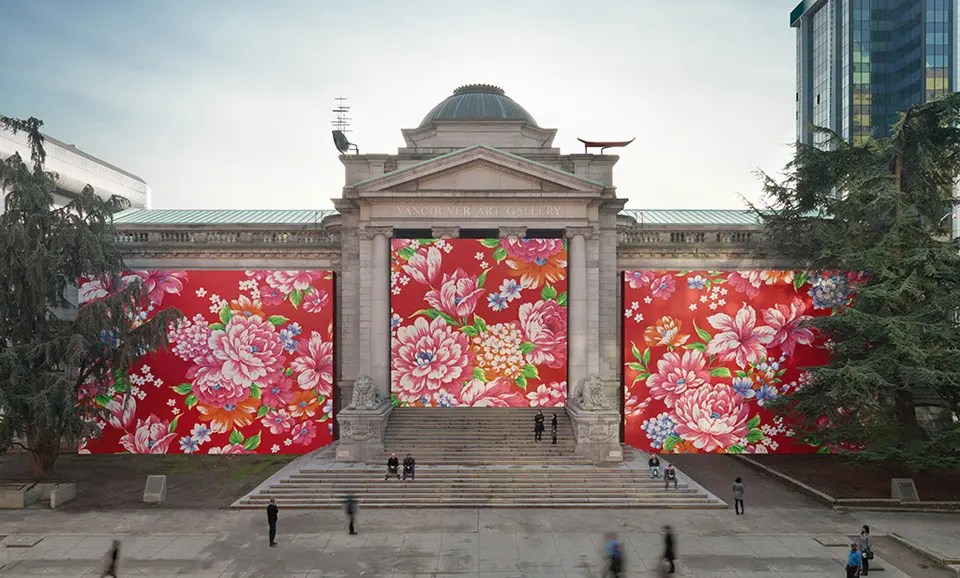
Central to Staff’s analysis is the concept of “situational aesthetics,” drawing on Victor Burgin’s 1969 theory (p. 147) to emphasise that an artwork’s meaning is contingent on its spatial and social context. He examines Francis Alÿs’s urban interventions, such as The Leak (1995), where paint drippings trace political and geographical narratives, illustrating how painting can act as a critique of ideological and institutional frameworks (pp. 10–11). This contrasts sharply with modernism’s formalist paradigm—epitomized by Clement Greenberg’s insistence on painting’s autonomous “essential state” (p. 153)—and instead foregrounds artists like Michael Lin, whose textile-patterned floor paintings transform galleries into sites of social interaction, aligning with Nicolas Bourriaud’s “relational aesthetics” (p. 155).
My practice, from the controlled Mangrove Forest to the material-collaborative Crystal Interweave, mirrors Staff’s narrative of transition from modernist constraints to situational and material agency. Staff’s analysis of artists “breaking free from rectangular frames” (p. 63) directly informs my experimentation with 3D materials like epoxy resin. In The Labyrinth, allowing resin to flow within pre-carved acrylic grooves embodies Staff’s concept of “partial autonomy” in transitional practices (p. 63), while Crystal Interweave’s organic, wall-protruding forms resonate with Grosse’s expansionist logic of painting as a “spatialisation” beyond the canvas (p. 144). Crucially, Staff’s emphasis on materials as “active collaborators” (p. 155) aligns with my adoption of Tim Ingold’s theory, where resin’s unpredictable behaviours—such as cracking during demolding—become co-creative forces that challenge anthropocentric control (pp. 144–145).
In essence, Staff’s scholarship provides a vital theoretical foundation for understanding my shift from formal control to a practice driven by material and situational dynamics. By situating my work within his analysis of painting’s post-modernist evolution—from Greenbergian autonomy to collaborative, context-responsive forms—I engage with a broader discourse on art’s relationship to space, politics, and material agency (pp. 143, 155).

This Drove my Mother up the Wall, 2017
The Leak, 2002
 Jimmy Zheng